Showing posts with label Doc. Show all posts

Types of whales in the world.

Whale statistics - these are very variable. If you do any research on whales on the internet, or in books, you will find that there are wide differences in the recorded length and mass of the various species. Lengths are generally more reliable than weights as it easier to measure the length of a whale, from whalers records or from photographs against objects of known size. The weight on the other hand is very difficult to measure and is often based on some rough measurements and estimates from those measurements of whales caught by whalers.

Unlike other animals it is not possible to guide a whale onto a weigh bridge or to suspend it from a crane to measure the weight (or even take it to the whale-weigh station, arf!). The only time whales have been available in quantity for such statistics was during the old whaling days and then it was most important to get them processed as quickly as possible before the next one arrived, so weights are educated guesses at best.

Blue whales

The largest animals ever to have lived, dwarfing even the largest dinosaurs. All figures about blues are awesome. Their circulatory system pumps 10 tonnes of blood through its body using a heart the size of a small car. A child could crawl down the whales' main blood vessel, the aorta. In its development, a blue whale calf can drink 50 gallons of its mother's milk and gain 200lbs per day!

The largest individuals have been estimated at being 150-200 tonnes.

Blue whales are light grey/blue to dark grey while at the surface, but seen underwater they are a luminous aqua blue.
Blue whales- types of whale

Right Whales

The name was given by the early whalers because they were the "right" whales to kill. They have large amounts of oil, blubber and baleen or whalebone, they are slow swimming (easy to catch), are often found close to shore and float when killed.

Right whales have a large bulbous head and lack the streamlined shape of other whales. The head has large callosities that are home to  a whole colony of whale barnacles, parasitic worms and whale lice.

Types of whale in the world.


Sei whales

These are among the more elusive of the larger whales, not coming very close to land at any time and not forming large groups or "schools". Sei is pronounced "Say"

They are found like many whales in both Northern and Southern hemispheres following the best feeding at different times of year. Only the larger older individuals tend to go very far south, they are relatively rare in Antarctica
Types of whale in the world.


Humpback whales

So called because of the habit of raising and bending the back in preparation for a dive, accentuating the hump in front of the dorsal fin.

Probably the best known of the large whales as they often collect in groups near to land and draw attention to themselves by their behaviour. Breaching, lob-tailing and flipper-slap are common and often occur several times in a row.

They are slow swimmers (allows tourist boats - and whalers - to get close). Males at breeding time sing the longest and most complex songs in the animal kingdom.

Types of whale in the world.

Minke whales

One of the smallest baleen or filter feeding whales. Minke numbers are still quite healthy due to whalers concentrating on larger, more profitable species.

Minkes are still hunted for "scientific" reasons by Japan, and large quantities of the meat turns up in expensive restaurants.
Types of whale in the world.

Fin whales

The second largest after the blue whale, the fastest swimming of all the large whales (sometimes called the greyhound of the seas) and the commonest large whale.

Fin whales can produce sounds of 75-80dB at around 100Hz which is very loud for an animal source. In pre-propeller oceans this sound could travel for well over a hundred kilometres.
Types of whale in the world.


Sperm whales

The name comes from the enormous bulbous spermaceti organ in the head. 

Only males are found in Antarctic waters. Sperm whales are toothed whales rather than filter feeders and are the deepest and longest of all whale divers catching giant squid in the dark ocean depths.

Unlike baleen whales, which form only temporary bonds, sperm whales live in extended family units that for the females are lifelong associations.
Types of whale in the world.

Killer whales

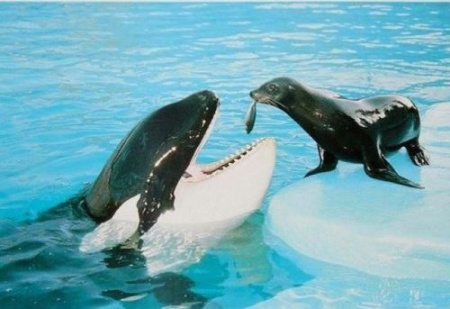
Also known as Orcas from their Latin name. They are one of the most well known types of whales thanks to their being held captive in marine aquariums where they are taught to perform tricks. 

Killer whales are toothed whales and top carnivores in their food chain. Sometimes referred to as "sea-wolves", they frequently hunt in packs or "pods". Their tastes are wide ranging from krill and fish to penguins, seals and even much larger baleen whales.
Types of whale in the world.
----------------------------------------------------------------------------
Types of whale in the world.
A comparison of the size of baleen whales, the bowhead and grey whales are not species found in Antarctica

5 Killer Whales Interesting Facts

Did you know that killer whales aren't actually whales? They are actually the world’s biggest dolphin. They have a number of special characteristics that make them a truly unique creature. Called Orcas to eliminate the confusion between whale and dolphin, these animals swim in pods and have a strong family bond, especially between mother and child. They thrive in the wild and can swim at speeds of up to 35 miles per hour.

If you have a love for killer whales, then here are some more interesting facts about them so that you can get to know these intelligent creatures a little more.

1. That’s a Lot of Teeth!

Orcas can have up to 56 teeth in their mouth. All of them are interlocking and they can be up to three inches long. The conical shape of their teeth makes them the perfect tool for tearing or ripping food, but not necessarily for chewing food. When killer whales are enjoying their dinner, then tend to just swallow the food whole.

orca teeth

They need to consistently eat to support their metabolism. It takes a lot of work to keep an 11 ton body moving in the ocean’s waters! Killer whales tend to grow to a length of about 19 feet, but some animals that have been observed can be over 30 feet long. That’s the same length it takes in American football to achieve a First Down.

2. They Don’t Live Well in Captivity

Orcas are animals that love the open sea. With their natural pod structure and emphasis on family, you can find them swimming together and occasionally breaching, just like with other dolphins. The problem that killer whales face in captivity is directly related to their size. Holding tanks for them provide a fraction of the space that they are used to having. Killer whales in captivity will also attack each other and be temperamentally different from those in the wild.

Orcas that live out in the wild can live for up to 80 years. The average lifespan of a wild killer whale is about 50 years. For killer whales that are held in captivity in places like SeaWorld, it is a very different story. Their lifespans are cut by 50% on average.

Part of the reason for this might be isolation, but another component is that the natural family structure is often artificially modified while in captivity. Young whales are often taken from their mothers at an early age for training purposes and the animals have show evidence of emotional trauma when this occurs. As with any built up stress, a negative health consequence is often the result.

3. They Are Extremely Stable Animals

The organized pods that the killer whales tend to form out in the waters of the ocean are some of the most stable animal family structures that we have ever observed. This stability translates into a number of unique facts about this animal.

No humans have ever been intentionally attacked by a killer whale that was living in the wild. When they recognize that it is a human that has been targeted, these animals will typically leave the area so that the human can be safe.

Their intelligence is one of the highest ever observed in the animal kingdom and pods have been known to fool human hunting parties through their strategies to keep their calves safe.

They regularly communicate with each other to form their own offensive and defensive movements when looking for food or having an animal attack them.

Much of this stability is attributed to the unique family structure of the pods. There can be three or four generations in a pod, all direct descendants of each other, and all working together to achieve a common good for the family. This creates a natural form of social networking that builds inter-whale relationships that keep the pod together and emotionally satisfied on the whole.

Orcas use a process called “echolocation” to communicate. This is a lot like a radar system that we use to identify objects. The soundwaves bounce off of the objects and the killer whales can then determine what that object is. They even have the ability to identify which type of fish is swimming by them by the echo that the fish makes.

What’s even more fascinating about this communication technique is the fact that scientists have observed different vocal “accents” within the echolocation. You know how someone from the southern United States will sound different vocally from someone who is from London? That’s the same thing that is going on with the different echolocation noises that Orcas can make.

4. The Women Rule the Day

It is the women who are in control of each Orca family pod. Most family units are controlled by the oldest female killer whale and then her calves, dependent older offspring, and potentially older male children continue to remain. Some pods have been known to pick up stray males from time to time as well. It’s easy to tell if you’re looking a girl Orca – her dorsal fin is smaller and curves, while the male dorsal fins is rather triangular and straight.

This is what makes the Orca a unique creature in the animal kingdom. The males almost always stick with their mother throughout their entire life. They might wander off for mating purposes for a few days because all of the girl killer whales in their pod are close relatives, but they always wind up coming back. A male killer whale is estimated to spend 40% of its entire life within one body length of its mother.

As with other animals, killer whales will still go through mating rituals and the males will compete for the privilege of being able to have a calve, but not all of the female Orcas are actually eligible Orcas. There is a unique component to pod life with this animal. They will not mate with another animal that is a close relative. Mates are chosen from those that are the furthest away from direct relations.

After the calves are born, the male whales actually assume the nurturing role. As the female orcas hunt, the males tend to do the calve-sitting that is required.

5. They Are Smart – Incredibly Smart

Why are killer whales so intelligent? Part of the reason might be the overall size of their brain. Scientists have discovered killer whales can have a brain that weighs up to 15 pounds. That’s almost 5 times heavier than your brain and it makes it one of the largest brains on the entire planet today that scientists know about.

This higher level of intelligence allows them to adapt to changing conditions more readily than other creatures. Killer whales don’t migrate like other dolphins tend to do. The pods might swim out together for several hundred miles to find fresh food that tastes better, but they always tend to return home after a time.

This intelligence also makes them a deadly predator out in the open sea. The Great White Shark tends to strike a fear into people, even just with its name, but it isn’t a true Apex predator. Orcas can kill and eat a Great White when working together as a pod. This makes them the true top of the food chain in the world’s oceans today.

That’s probably a good thing – killer whales need a lot to eat. The average Orca will eat enough food to equal about 5% of their total body weight every day. In practical terms, that’s about 500 pounds of food that is required.

what the orca eat

Killer whales are one of the world’s most fascinating creatures, so wanting to see them and get to know them is completely understandable. Thanks to facts like these and the work of scientists who love Orcas as much as you do, we can get to know these majestic animals on a personal level without having to keep them in activity. If you want a truly life changing experience, go on a whale watching expedition that includes Orcas and you will have a much better time than seeing a big killer whale in a tiny tank.

What do the orca eat?

Killer whales are apex predators, meaning that they themselves have no natural predators. They are sometimes called the wolves of the sea, because they hunt in groups like wolf packs. Killer whales hunt varied prey including fish, cephalopods, mammals, sea birds and sea turtles. However, different populations or species tend to specialize and some can have a dramatic impact on certain prey species.Those that feed on mammals may not even recognize fish as food. This specialization in diet and hunting, combined with small differences in markings, suggest that they might be different species, rather than populations. Advanced methods that sequenced the entire mitochondrial genome revealed systematic differences in DNA between different populations.

Fish

what do orca whales eat
Tail-slapping in Vestfjorden, Norway
Fish-eating killer whales prey on around 30 species of fish. Some populations in the Norwegian and Greenland sea specialize in herring and follow that fish's autumnal migration to the Norwegian coast. Salmon account for 96% of northeast Pacific residents' diet. About 65% of them are large, fatty Chinook. Chum salmon are also eaten, but smaller sockeye and pink salmon are not a significant food item. Depletion of specific prey species in an area is, therefore, cause for concern for local populations, despite the high diversity of prey. On average, a killer whale eats 227 kilograms (500 lb) each day. While salmon are usually hunted by an individual or a small group of individuals, herring are often caught using carousel feeding; the killer whales force the herring into a tight ball by releasing bursts of bubbles or flashing their white undersides. They then slap the ball with their tail flukes, either stunning or killing up to 10–15 fish at a time. The herring are then eaten one at a time. Carousel feeding has only been documented in the Norwegian killer whale population and with some oceanic dolphin species.

orca eat fish
Resident (fish-eating) killer whales: The curved dorsal fins are typical of resident females.
In New Zealand, sharks and rays appear to be important prey; species taken include eagle rays, long-tail and short-tail stingrays, common threshers, smooth hammerheads, blue sharks and shortfin mako sharks. With sharks, orcas may herd them to the surface and strike them with their tail flukes, while bottom-dwelling rays are flushed out with bubble-blowing before being cornered and pinned to the ground and taken to the surface.Killer whales can induce tonic immobility in sharks and rays by holding them upside down, rendering them helpless and incapable of injuring the whale. Some sharks suffocate within about 15 minutes while the whale holds them still, because these sharks need to move to breathe. In one incident filmed near the Farallon Islands in October 1997, a 4.7–5.3-metre (15–17 ft) female killed a 3–4-metre (9.8–13.1 ft) great white shark, apparently after swimming with it upside-down in her mouth and inducing tonic immobility in it. She and another pod member ate the shark's liver and allowed the rest of the carcass to sink. Interspecific competition between the two species is probable in regions where dietary preferences overlap.

In July 1992, two killer whales attacked, killed and fed on an 8-metre (26 ft) long whale shark, Rhincodon typus, in the waters off Bahia de los Angeles in Baja California.

Mammals and birds

Killer whales are very sophisticated and effective predators of marine mammals. Thirty-two cetacean species have been recorded as killer whale prey, from examining either stomach contents, scarring on the prey's body, or feeding activity. Groups even attack larger cetaceans such as minke whales, gray whales, and rarely sperm whales or blue whales.

Hunting large whales usually takes several hours. Killer whales generally choose to attack young or weak animals, instead. However, a group of five or more may attack a healthy adult. When hunting a young whale, a group chases it and its mother until they wear out. Eventually, they separate the pair and surround the calf, preventing it from surfacing to breathe, drowning it. Pods of female sperm whales sometimes protect themselves by forming a protective circle around their calves with their flukes facing outwards, using them to repel the attackers. Rarely, large killer whale pods can overwhelm even adult female sperm whales. Adult bull sperm whales, which are large, powerful and aggressive when threatened, and fully grown adult blue whales, which are possibly too large to overwhelm, are not believed to be prey for killer whales.

Prior to the advent of industrial whaling, great whales may have been the major food source for killer whales. The introduction of modern whaling techniques may have aided killer whales by the sound of exploding harpoons indicating availability of prey to scavenge, and compressed air inflation of whale carcasses causing them to float, thus exposing them to scavenging. However, the toll on great whale populations by unfettered whaling had possibly reduced their availability as prey for killer whales, and caused them to expand their consumption of smaller marine mammals, thus contributing to their decline as well.

Predation by orcas on whale calves in high productivity, high latitude areas has been hypothesised to be the reason for great whale migrations to low productivity tropical waters, ostensibly to reduce the risk of attacks on the highly vulnerable calves due to lower density of orcas in these waters.

Fish-eating killer whales prey on around 30 species of fish
Killer whale hunting a Weddell seal
Other marine mammal prey species include nearly 20 species of seal, sea lion and fur seal. Walruses and sea otters are less frequently taken. Often, to avoid injury, killer whales disable their prey before killing and eating it. This may involve throwing it in the air, slapping it with their tails, ramming it, or breaching and landing on it. Sea lions are killed by head-butting or after a stunning blow from a tail fluke. In the Aleutian Islands, a decline in sea otter populations in the 1990s was controversially attributed by some scientists to killer whale predation, although with no direct evidence. The decline of sea otters followed a decline in harbour seal and Steller sea lion populations, the killer whale's preferred prey, which in turn may be substitutes for their original prey, now decimated by industrial whaling.

In steeply banked beaches off Península Valdés, Argentina, and the Crozet Islands, killer whales feed on South American sea lions and southern elephant seals in shallow water, even beaching temporarily to grab prey before wriggling back to the sea. Beaching, usually fatal to cetaceans, is not an instinctive behavior, and can require years of practice for the young.Killer whales can then release them again near juvenile whales, allowing the younger whales to practice the difficult capture technique on the now-weakened prey. "Wave-hunting" killer whales spy-hop to locate Weddell seals, crabeater seals, leopard seals, and penguins resting on ice floes, and then swim in groups to create waves that wash over the floe. This washes the prey into the water, where other killer whales lie in wait.

Killer whales have also been observed preying on terrestrial mammals, such as deer and moose swimming between islands off the northwest coast of North America. Killer whale cannibalism has also been reported based on analysis of stomach contents, but this is likely to be the result of scavenging remains dumped by whalers. One killer whale was also attacked by its companions after being shot. Although resident killer whales have never been observed to eat other marine mammals, they occasionally harass and kill porpoises and seals for no apparent reason.

Killer whales in many areas may also prey on cormorants and gulls. A captive killer whale at MarineLand discovered it could regurgitate fish onto the surface, attracting sea gulls, and then eat the birds. Four others then learned to copy the behavior.

Types of killer whales

The three to five types of killer whales may be distinct enough to be considered different races, subspecies, or possibly even species. The IUCN reported in 2008, "The taxonomy of this genus is clearly in need of review, and it is likely that O. orca will be split into a number of different species or at least subspecies over the next few years. Although large variation in the ecological distinctiveness of different killer whale groups complicate simple differentiation into types, research off the west coast of Canada and the United States in the 1970s and 1980s identified the following three types:

Resident: These are the most commonly sighted of the three populations in the coastal waters of the northeast Pacific. Residents' diets consist primarily of fish and sometimes squid, and they live in complex and cohesive family groups called pods. Female residents characteristically have rounded dorsal fin tips that terminate in a sharp corner. They visit the same areas consistently. British Columbia and Washington resident populations are among the most intensively studied marine mammals. Researchers have identified and named over 300 killer whales over the past 30 years.
Transient: The diets of these whales consist almost exclusively of marine mammals. Transients generally travel in small groups, usually of two to six animals, and have less persistent family bonds than residents. Transients vocalize in less variable and less complex dialects.Female transients are characterized by more triangular and pointed dorsal fins than those of residents. The gray or white area around the dorsal fin, known as the "saddle patch", often contains some black colouring in residents. However, the saddle patches of transients are solid and uniformly gray. Transients roam widely along the coast; some individuals have been sighted in both southern Alaska and California. Transients are also referred to as Bigg's killer whale in honor of Michael Bigg. The term has become increasingly common and may eventually replace the transient label.
Offshore: A third population of killer whales in the northeast Pacific was discovered in 1988, when a humpback whale researcher observed them in open water. As their name suggests, they travel far from shore and feed primarily on schooling fish. However, because they have large, scarred and nicked dorsal fins resembling those of mammal-hunting transients, it may be that they also eat mammals and sharks.They have mostly been encountered off the west coast of Vancouver Island and near the Queen Charlotte Islands. Offshores typically congregate in groups of 20–75, with occasional sightings of larger groups of up to 200.Currently, little is known about their habits, but they are genetically distinct from residents and transients. Offshores appear to be smaller than the others, and females are characterized by dorsal fin tips that are continuously rounded.
Killer whale mother and calf extending their bodies above the water surface, from pectoral fins forward, with ice pack in background
Type C killer whales in the Ross Sea: The eye patch slants forward.
Transients and residents live in the same areas, but avoid each other.The name "transient" originated from the belief that these killer whales were outcasts from larger resident pods. Researchers later discovered transients are not born into resident pods or vice versa. The evolutionary split between the two groups is believed to have begun two million years ago. Genetic data indicate the types have not interbred in the wild for up to 10,000 years.

Other populations have not been as well studied, although specialized fish-eating and mammal-eating killer whales have been distinguished elsewhere.[38] Separate populations of fish-eating and mammal-eating killer whales have been identified around the United Kingdom. As with residents and transients, the lifestyle of these whales appears to reflect their diet; fish-eating killer whales in Alaska and Norway have resident-like social structures, while mammal-eating killer whales in Argentina and the Crozet Islands behave more like transients.

Three types have been documented in the Antarctic. Two dwarf species, named Orcinus nanus and Orcinus glacialis, were described during the 1980s by Soviet researchers, but most cetacean researchers are skeptical about their status, and linking these directly to the types described below is difficult.
types of killer whales

Some examples of variations in killer whales
Type A looks like a "typical" killer whale, a large, black and white form with a medium-sized white eye patch, living in open water and feeding mostly on minke whales.
Type B is smaller than type A. It has a large white eye patch. Most of the dark parts of its body are medium gray instead of black, although it has a dark gray patch called a "dorsal cape" stretching back from its forehead to just behind its dorsal fin. The white areas are stained slightly yellow. It feeds mostly on seals.
Type C is the smallest type and lives in larger groups than the others. Its eye patch is distinctively slanted forwards, rather than parallel to the body axis. Like type B, it is primarily white and medium gray, with a dark gray dorsal cape and yellow-tinged patches. Its only observed prey is the Antarctic cod.
type of orca
Type C killer whales in the Ross Sea: The eye patch slants forward.

Type D was identified based on photographs of a 1955 mass stranding in New Zealand and six at-sea sightings since 2004. It is immediately recognizable by its extremely small white eye patch, shorter than usual dorsal fin, and bulbous head (similar to a pilot whale). Its geographic range appears to be circumglobal in subantarctic waters between latitudes 40°S and 60°S. And although nothing is known about the type D diet, it is suspected to include fish because groups have been photographed around longline vessels where they reportedly prey on Patagonian toothfish (Dissostichus eleginoides).
Types B and C live close to the ice pack, and diatoms in these waters may be responsible for the yellowish coloring of both types. Mitochondrial DNA sequences support the theory that these are recently diverged separate species.More recently, complete mitochondrial sequencing indicates the two Antarctic groups that eat seals and fish should be recognized as distinct species, as should the North Pacific transients, leaving the others as subspecies pending additional data.

Mammal-eating killer whales were long thought likely to be closely related to other mammal-eating killer whales from different regions, but genetic testing refuted this hypothesis.

The identified seven ecotypes in isolated ecological niches. Of three orca ecotypes in the Antarctic, one preys on minke whales, the second on seals and penguins and the third on fish. Another ecotype lives in the eastern North Atlantic, while the three Northeast Pacific ecotypes are labeled the transient, resident and offshore populations. The research supported a proposal to reclassify the Antarctic seal- and fish-eating populations and the North Pacific transients, should be recognized as distinct species, leaving the remaining ecotypes as subspecies. The first split in the orca population, between the North Pacific transients and the rest, occurred an estimated 700,000 years ago. Such a designation would enable/require that each new species be subject to separate conservation assessments.

Common name of Orca .

killer whales jumping


The killer whale (Orcinus orca), also referred to as the orca whale or orca, and less commonly as the blackfish or grampus, is a toothed whale belonging to the oceanic dolphin family. Killer whales are found in all oceans, from the frigid Arctic and Antarctic regions to tropical seas. Killer whales as a species have a diverse diet, although individual populations often specialize in particular types of prey. Some feed exclusively on fish, while others hunt marine mammals like pinnipeds, and even large whales. Killer whales are regarded as apex predators, lacking natural predators.

Killer whales are highly social; some populations are composed of matrilineal family groups which are the most stable of any animal species.Their sophisticated hunting techniques and vocal behaviors, which are often specific to a particular group and passed across generations, have been described as manifestations of culture.

The IUCN currently assesses the orca's conservation status as data deficient because of the likelihood that two or more killer whale types are separate species. Some local populations are considered threatened or endangered due to prey depletion, habitat loss, pollution (by PCBs), capture for marine mammal parks, and conflicts with fisheries. In late 2005, the "southern resident" population of killer whales that inhabits British Columbia and Washington state waters were placed on the U.S. Endangered Species list.

Wild killer whales are not considered a threat to humans, but there have been cases of captive orcas killing or injuring their handlers at marine theme parks. Killer whales feature strongly in the mythologies of indigenous cultures, with their reputation ranging from being the souls of humans to merciless killers.

Common names
English-speaking scientists most often use the term "killer whale", although the term "orca" is increasingly used. Killer whale advocates point out it has a long heritage. Indeed, the genus name Orcinus means "of the kingdom of the dead", or "belonging to Orcus". Ancient Romans originally applied orca (plural orcae) to these animals, possibly borrowing it from the Greek ὄρυξ, which referred (among other things) to a whale species. Since the 1960s, orca has steadily grown in popularity; both names are now used. The term orca is preferred by some to avoid the negative connotations of "killer", and because, being part of the family Delphinidae, the species is more closely related to other dolphins than to whales.

According to some authors, the name killer whale would be a mistranslation of the 18th century Spanish name asesina ballenas which means literally whale killer. Basque whalers would have given it such name after observing pods of orcas hunting their own prey.

They are sometimes referred to as blackfish, a name used for some whale species, as well. Grampus is a former name for the species, but is now seldom used. This meaning of grampus should not be confused with the Grampus genus, whose only member is Risso's dolphin.
Powered by Blogger.